





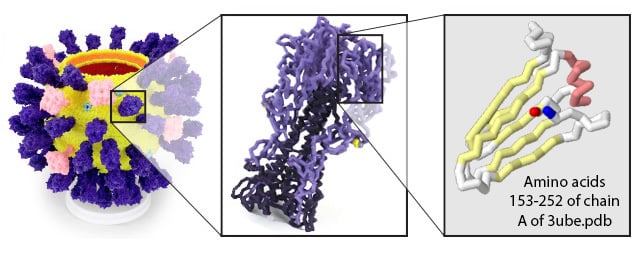
The 3ube.pdb structure file includes one complete copy of the hemagglutinin protein, the envelope protein that covers the outer surface of the influenza virus. The hemagglutinin protein is a trimer (a protein made up of three identical monomers) that folds into a stalk-like quaternary structure.
The hemagglutinin protein is involved in both the attachment of the virus to a host cell membrane (by binding to sialic acid sugars) and the fusion of the viral membrane to the host cell membrane, allowing for the viral genome to be released.
The specific region to be modeled, residues 153-252 of chain A of the protein structure file 3UBE.pdb, includes the sialic acid binding domain and common antigenic drift loops.
- Prebuild and Invitational Event Jmol User Design Environment (JUDE): https://learn.3dmoleculardesigns.com/2026-27-prebuild
- Prebuild Modeling Kits: https://shop.3dmoleculardesigns.com/products/protein-structure-modeling-kit
- Structure-function Summary: https://pdb101.rcsb.org/motm/76
- Scientific Article: https://journals.asm.org/doi/10.1128/jvi.06322-11
- Protein Databank Reference:https://www.rcsb.org/structure/3UBE
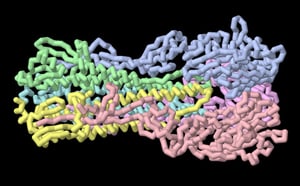 The Hemagglutinin Protein is a Trimer
The hemagglutinin protein has more than one protein chain. It is made up of three identical "monomers", each comprised of two protein chains, for a total of six chains in a full hemagglutinin protein.
Your prebuild model should represent amino acid residues 153-252 of chain A.
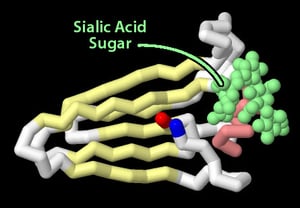 The Sialic Acid Sugar
This year's prebuild represents the sialic acid binding domains in the hemagglutinin protein. The structure file includes the sialic acid sugar itself!
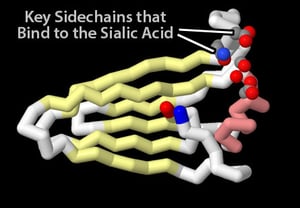 The Sialic Acid Binding Sidechains
You may want to explore how the sialic acid structure fits into the hemagglutinin protein. Specific amino acid sidechains, discussed in detail in figure 1 and figure 2 of the 3ube.pdb scientific article, interact with key regions of the sialic acid sugar to bind tightly to it.
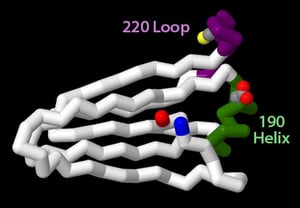 Antigenic Drift Regions
It is common to see seasonal changes (mutations) to the sialic acid binding domain of the hemagglutinin protein. Over time, these mutations allow the influenza virus to evade existing antibody recognition, overcome vaccination and sometimes even jump from infecting one species to infecting a different species (ie: swine or birds).
These key regions are discussed in detail in figure 5 of the 3ube.pdb scientific article, including the key mutations that led to the 2009 influenza virus pandemic.
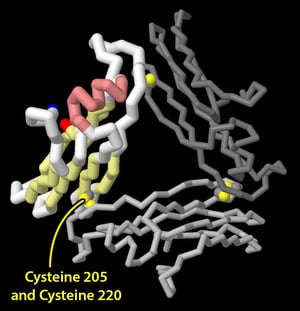 Trimer Cysteine Sidechains
The hemagglutinin protein has three protein chains. Proteins with more than one chain are said to have quaternary structure.
Specific cysteine amino acids in each of the three identical chains in the hemagglutinin protein are involved in holding the three chains together. These sidechains form a specific type of covalent bond called a disulfide bond.