





.png?width=2000&height=204&name=Phospholipids%20(1).png "Phospholipids (1)")
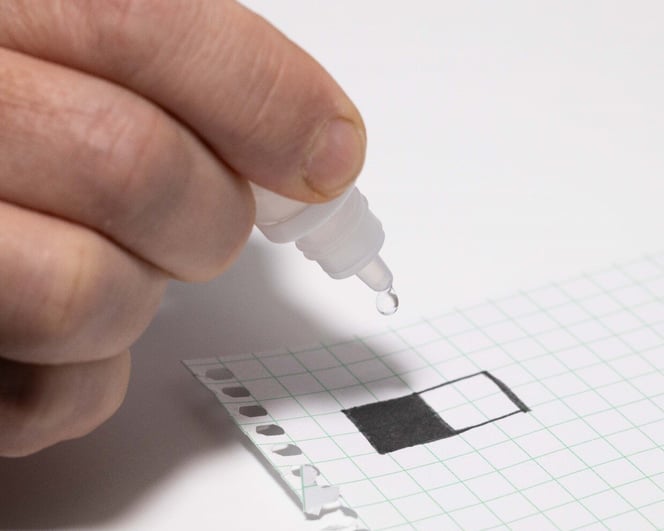
Experiment: You will need a clean sheet of paper, a pencil, a dropper (optional), and a glass of water.

On your sheet of paper, or in your lab notebook, draw two one-inch x one-inch boxes. Color one box completely with a pencil. Try to make it as dark as you can by coloring it multiple times.
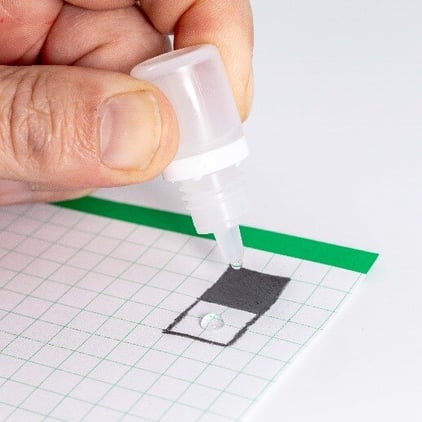
Add a drop of water to the center of each box. If you don’t have a dropper, you can dip a finger in the water and let it drop onto each box. Set a timer and observe what happens for the next 60 seconds.
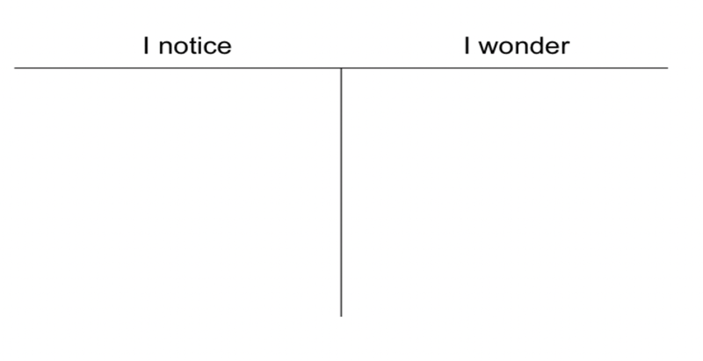
Create a Notice | Wonder Chart to help you record your observations. Draw the chart on a new page in your notebook. Leave enough room to add your observations and questions throughout the activity.

- List 5 observations in the notice column
- Record questions you have in the wonder column
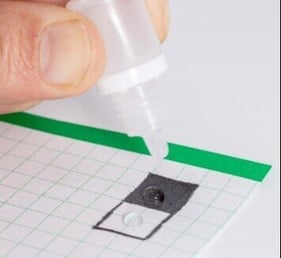
Time: 0 Seconds
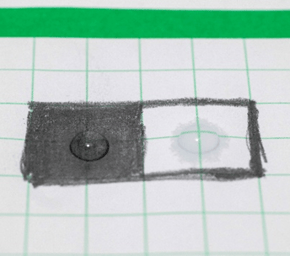
Time: 15 Seconds
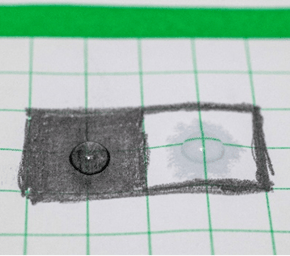
Time: 30 Seconds
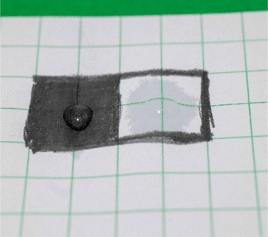
Time: 45 seconds
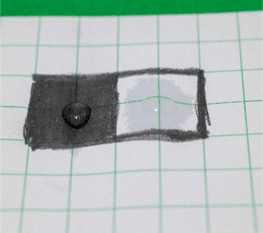
Time: 60 Seconds
 Pick the piece of paper up while trying to keep it flat and hold it by a light. Look at it from below.
- Record additional observations and questions in your Notice | Wonder Chart.
In your water lesson, you discovered that water is a polar molecule because it does not share electrons equally between oxygen and hydrogen. Carbon, which makes up most of the graphite in your pencil, does share electrons equally with hydrogen. This makes graphite non-polar.
Add the following to your lab notebook:

- What happened to the water you just put on the paper?
- What does this tell you about the properties of paper?
Phospholipids
Humans are made of cells – about 30 trillion of them. Each cell is surrounded by a cell membrane. This membrane separates the inside of the cell (the cytoplasm) from the outside. Cell membranes are made up of phospholipids. The chemical structure of a phospholipid is unusual in that part of it is polar, and part of it is non-polar. The amazing thing about phospholipids is that when they are added to water, they will spontaneously arrange themselves into a membrane – which is what we will explore today.

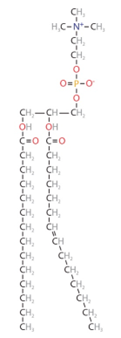
Look closely at these two images of phospholipids. Which part of the phospholipid do you think is similar to water? Which part is more like graphite or methane?

- Sketch a phospholipid.
- Label the part of the phospholipid that you think will act like water as POLAR.
- Label the part of the phospholipid that you think will act like graphite as NONPOLAR.
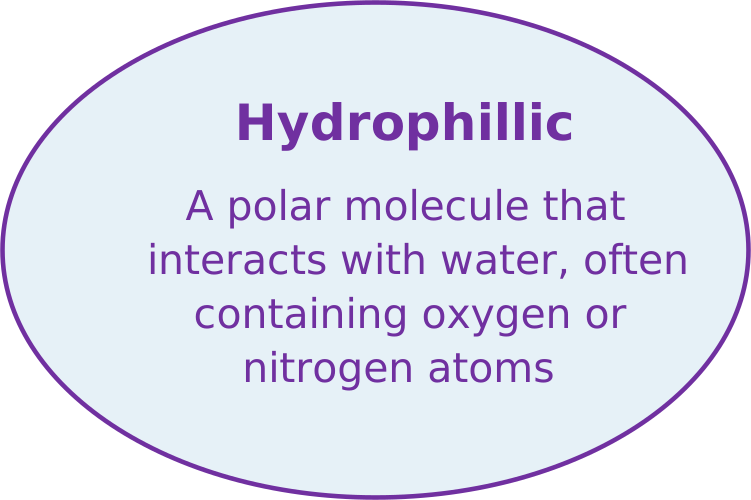
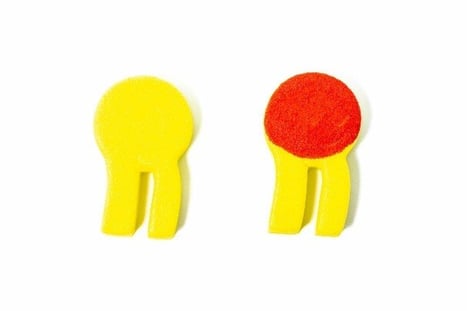
This is a schematic model of a phospholipid. The polar part of the molecule is represented by a red circle. Since polar molecules like to interact with water, they are often called hydrophilic. In the case of a phospholipid, it is called a hydrophilic head.
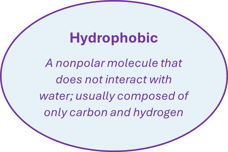
The yellow parts are often referred to as tails. These tails are nonpolar and try to be in areas that exclude water, or hydrophobic. In the case of a phospholipid, they are called hydrophobic tails.

Add this information to your sketch in you lab notebook:

- Hydrophilic Head
- Hydrophobic Tails
Next, pull out the phospholipid pieces from your Student Modeling Pack and color the heads red.
Most of the environment surrounding a cell is made of water. Can you find pieces in your kit that resemble water molecules (H2O)? Color in the red oxygens.
.png?width=495&height=330&name=Untitled%20design%20(7).png)
In your lab notebook:

- Draw a water molecule and label its atoms.
- Add a plus sign by the hydrogens to indicate its partial positive charge.
- Add a negative sign by the oxygen to indicate its partial negative charge.
Either print the following page, or sketch a beaker of water on a piece of paper, or a whole page in your lab notebook.
Note: The water molecules in this model are much larger so that you can investigate the interactions. If the phospholipids were at the same scale as the water, they would need to be 10X the size.
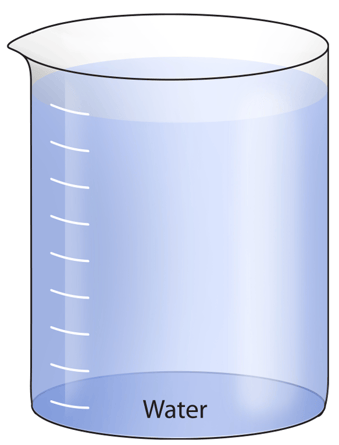
Place your water molecules into the beaker. Think about how they may interact with each other.
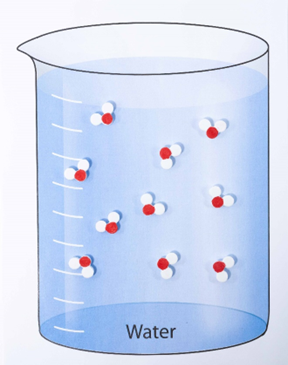
Remember that water is a polar molecule. In water, hydrogen is partially positive, and oxygen is partially negative.
Take 6 phospholipids and create a model of how they would interact with water in your beaker, as if they were floating on the surface.
How would the phospholipids be arranged? In your lab notebook:
- Sketch your prediction of the phospholipids and water in the beaker.
- Explain your sketch in a sentence or two
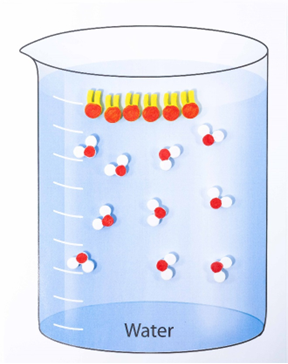
The hydrophilic heads of each phospholipid would interact with the water in the beaker. The hydrophobic tails would try to stay out of the water.
Edit your sketch & explanation, if necessary, in your lab notebook.
In your lab notebook:

- Sketch your prediction of the phospholipids submerged in the beaker.
- Explain your sketch in a sentence or two.
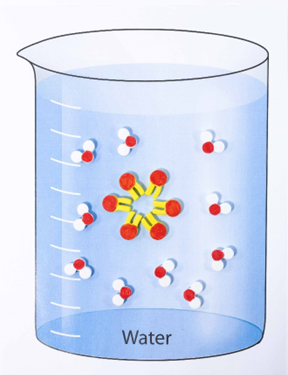
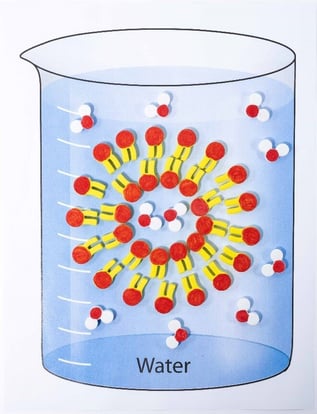
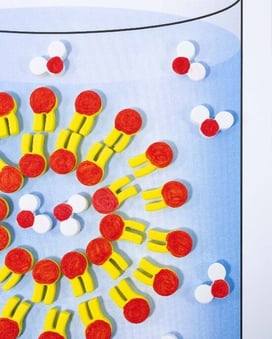
Again, the hydrophilic heads would interact with the water all around them, while the hydrophobic tails would reach into the center and interact with the other hydrophobic tails, excluding any water molecules from the center.
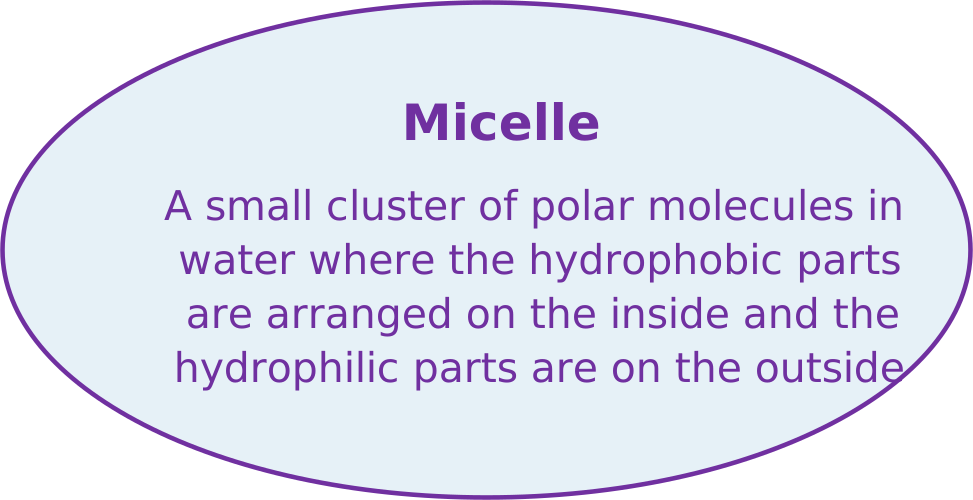
This arrangement of phospholipids is known as a micelle.
Edit your sketch & explanation, if necessary, in your lab notebook.
With higher concentrations, phospholipids will form structures with some water molecules on the inside. Use the additional phospholipids as needed to create a model allowing water on both sides, like a cell. What would change? What would stay the same? How would it look?
In your lab notebook:

- Sketch your prediction of the water and phospholipids.
- Explain your sketch in a sentence or two.
Two layers of phospholipid come together so that the hydrophobic tails can interact with each other. The polar heads can interact with water both inside and outside the cell, providing the cell's outer boundary.
You have just discovered how phospholipids will spontaneously form lipid bilayers in water, creating membranes that separate the inside of a cell from the outside.
Edit your sketch & explanation, if necessary, in your lab notebook.
The model you created is a flat, 2-D structure. Life and biology happen in three dimensions. You have just modeled the spontaneous formation of a lipid bilayer in two dimensions. Can you imagine how this looks in three dimensions?
In your lab notebook:

- Sketch a lipid bilayer in three dimensions.
- Add labels to enhance your sketch

Looking Back
Review your notes in your lab notebook. What consistent themes do you see?

- Write a rule about the structure of a phospholipid and how they interact with each other.
- Write a rule about how phospholipids interact with other molecules.
Let's summarize what we learned
- Polar vs non-polar: Water is a polar molecule that will interact with other polar molecules. Water does not interact with non-polar molecules.
- Phospholipids: Phospholipids have polar, hydrophilic heads and non-polar, hydrophobic tails.
- Phospholipid bilayer: the hydrophobic tails face each other, while the hydrophilic heads face outward.
- Cell Membrane Structure: Phospholipids form a bilayer with water on both sides, creating a boundary. Water molecules interact with the hydrophilic heads, while the hydrophobic tails stay together in the center, forming the membrane's structure.