






Wondering about Water
Take out the pieces from your Water Kit or Water Student Modeling Pack. Play with the parts and discover how they interact.
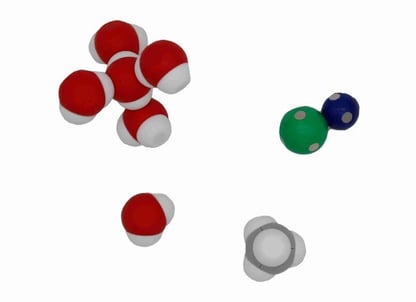
Create a Notice | Wonder Chart in your lab notebook. Draw the chart on a new page in your notebook. Leave enough room to add your observations and questions throughout the activity.

- List 5 observations in the notice column
- Record 5 questions you have in the wonder column
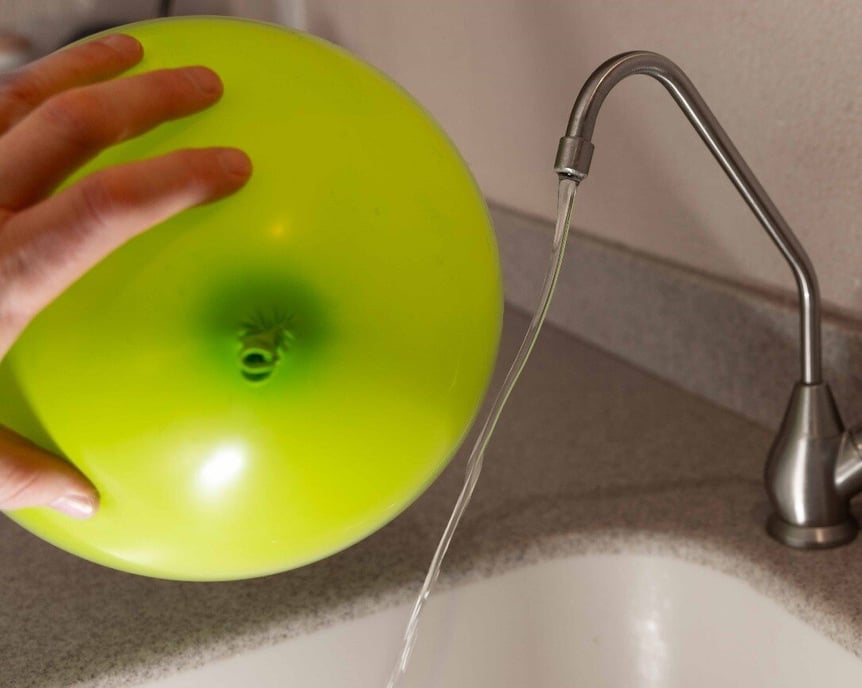
Now, look closely at the picture of a balloon held next to a stream of water.
Create a Notice | Wonder Chart in your lab notebook. Draw the chart on a new page in your notebook. Leave enough room to add your observations and questions throughout the activity.
- Describe five details that you see.
- How does what you see differ from how water usually runs out of a faucet?
- Can you connect anything in this image to the parts you played with above?
Workings between Water Particles
Look at one water molecule
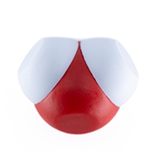
Answer the questions below in your notebook’s Notice | Wonder chart
- What do you notice about the parts?
- What do the red and white plastic pieces represent?
The chemical formula for water is H2O.
Add this information to your Notice | Wonder chart, and answer the following questions.
- What part of the model represents the hydrogen atom?
- What part of the model represents the oxygen atom?
- What does the 2 stand for the equation?
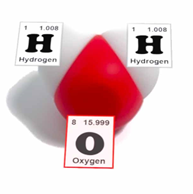
Water at the molecular level is colorless. In the model, oxygen is represented by a red atom. There is only one oxygen atom. When only one atom is present, no number is put in the chemical formula. It is assumed that if only the element symbol is present, there is one atom. There are two white hydrogen atoms. The 2 in the chemical formula represents the number of hydrogen atoms.
Within every atom are smaller particles: electrons, protons, and neutrons. Electrons move around the center of the atom where the protons and neutrons are located.
Make a sketch in your notebook under your Notice | Wonder chart showing how the interior of an atom might look. Be sure to label the electrons, protons, and neutrons.

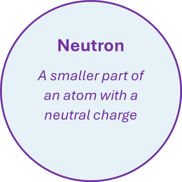

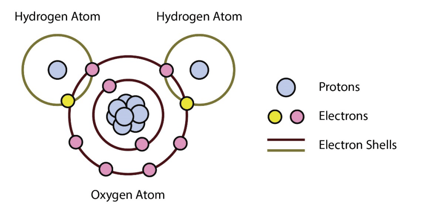
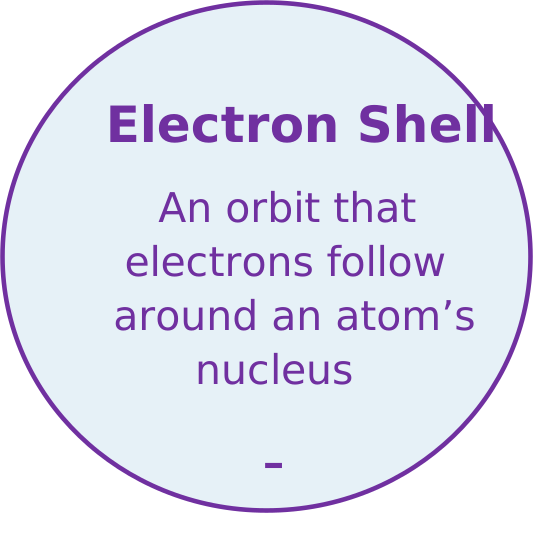
Although many atoms like oxygen have numerous electrons, only the electrons that are furthest from the nucleus are responsible for interactions between other atoms. Notice in the model of the oxygen atom shown below that electrons are shown in electron shells and the protons are shown in the center of the atom. In this model, neutrons are not shown. They would also be in the center of the atom with the protons.
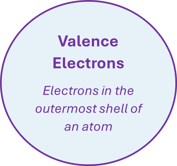
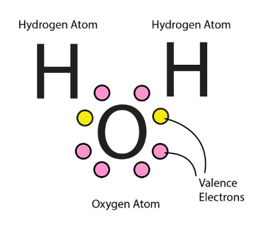
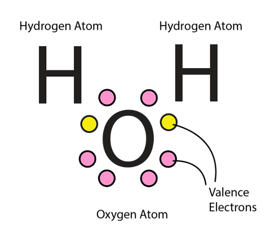 Scientists use the term valence electrons to refer to those electrons in the outermost shell of an atom. Valence electrons are responsible for forming chemical bonds. Scientists even use a special shorthand that only focuses on the electrons involved in those interactions, as shown in the image. Hydrogen has only 1 electron, as a result, it has 1 valence electron (shown in yellow). Oxygen has 8 electrons (shown in pink), with 2 electrons in the inner shell and 6 valence electrons (in the outer shell).
Let’s look at how water interacts with other water molecules. 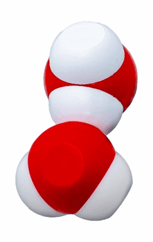
Bring two water molecules close together and explore how they interact.
Think about the questions below, and write your answers in your notebook.

- What parts of the model move toward each other?
- What parts of the model move away from each other?
- Sketch your model and label the parts in your notebook.
You should notice that the hydrogen atom in the model is attracted to the oxygen atom. If you try to bring an oxygen atom near another oxygen atom, it will be repelled. If you try to bring a hydrogen atom near another hydrogen atom, it will also be repelled.
Create a new Notice | Wonder and label it: Predictions about Valence Electrons.
- Why do you think hydrogens and oxygens on separate water molecules attract?
- Why do you think hydrogens to hydrogens or oxygens to oxygens from separate water molecules repel each other?
- Draw a model in your notebook like the one on the previous page to show how the valence electrons of two water molecules might interact. Use the image to help you get started.
Model what happens when you bring many water molecules close together. 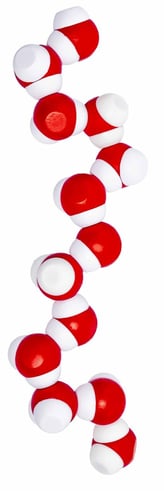
Write your discoveries in your notebook in your Notice | Wonder chart.
- How do multiple water molecules act when they are close to each other?
If the hydrogen atom bonds with an oxygen atom, you can add as many water molecules in a chain as you have. They will form a staggered chain.
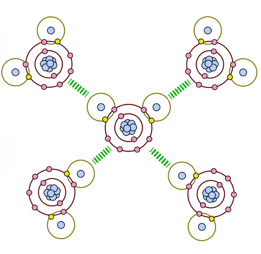 The water model uses magnets to mimic the workings between atoms. Atoms are not magnetic. Electrons in an atom have a negative charge. The movement of these electrons causes water particles to come together. A magnet's north and south poles can be used to show the partial positive and partial negative charges on the water molecule.
At the molecular level, when the oxygens of two different water molecules come together, they push each other away. This is also true of two hydrogen atoms. The oxygen of one water molecule will be pulled to the hydrogen of another water molecule. When this happens, it is known as hydrogen bonding. The hydrogen bonds are shown in green.

- How many electrons do you notice in the electron shell of hydrogen?
- How many electrons are in the outer shell of oxygen?
In the model, the hydrogen atom has one electron in its shell. It only has one electron shell. The model of the oxygen atom has six electrons in its outer shell. These valence electrons are important in forming chemical bonds.
To better understand how hydrogen bonding occurs you need to understand why there are different types of chemical bonds.
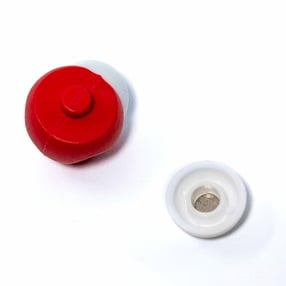
Remove a hydrogen atom from the water molecule.
Answer the questions below in your notebook.

- What do you notice about the parts?
- What does the post represent?
- What does the magnet represent?
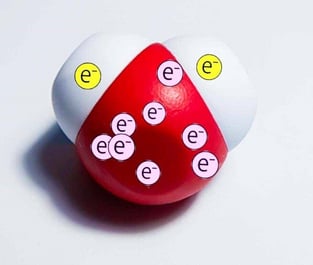
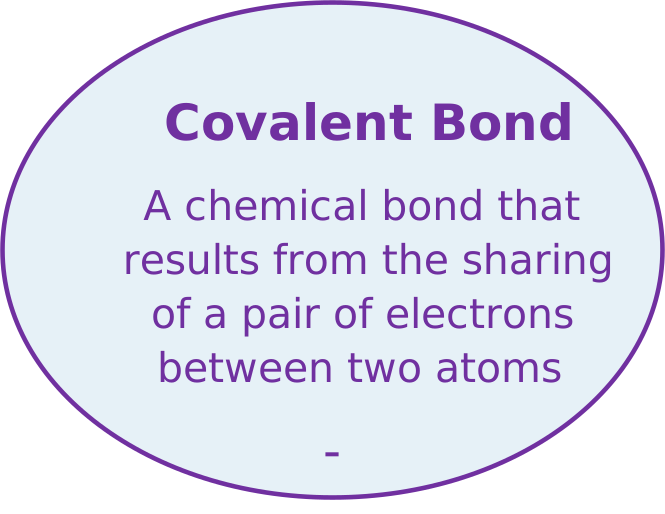
The post on the oxygen atom represents a covalent bond. Covalent bonds are formed when valence electrons are shared. Electrons are in constant motion. Sometimes the electrons are in their proper electron shell.
At other times, electrons move into each other’s electron shell. An electron from the oxygen can briefly move into one of the hydrogen atoms' electron shells, giving it one additional electron.
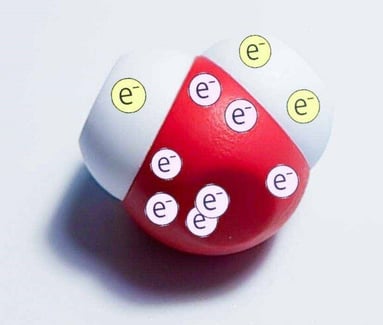
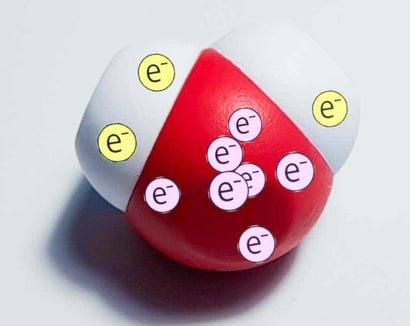
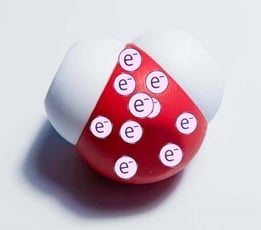
The electrons from the hydrogen atoms might also occupy the electron shell of the oxygen atom. All of this is happening faster and smaller than the human eye can see.
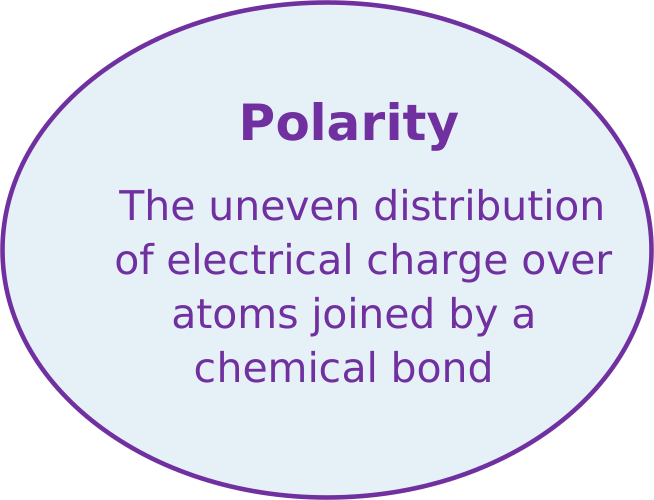
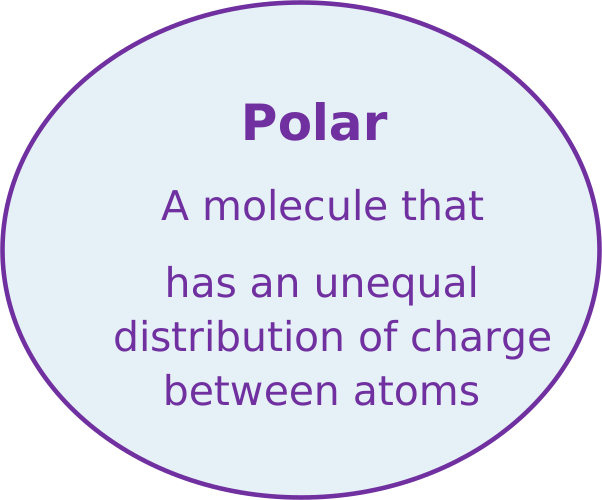
This uneven sharing of electrons causes the water molecule to have a slightly negative charge on the oxygen atom and slightly positive charges on the hydrogen atoms. Scientists call the separation of charge on a molecule its polarity. Different molecules have a range of polarity.
Let’s look back at this image to understand why water is slightly negative in some regions and slightly positive in others. In this image, only the protons are shown in the nucleus.

Record your answers in your Notice | Wonder Chart.
- How many protons are in the nucleus of hydrogen?
- How many electrons are in the electron shell of hydrogen?
- How many protons are in the nucleus of oxygen?
- How many electrons are in both electron shells of oxygen?
Under normal conditions, protons never leave the nucleus of the atom. Hydrogen atoms always have one proton, and oxygen atoms always have eight protons. The number of protons determines an element's identity. Each proton is positively charged.
Unlike protons, electrons are negatively charged and do not stay in one place in the atom. Instead, they orbit around the positively charged nucleus at very high speeds, creating what can be thought of as a negatively charged electron cloud.
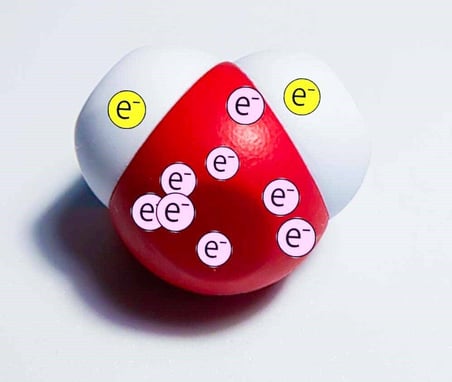 When two hydrogen atoms are bonded to one oxygen to form a water molecule, all 10 of the electrons from these three atoms can be thought of as forming an electron cloud around the water molecule. Because the nucleus of oxygen has 8 protons, it has a greater attraction for the 10 electrons of water than the nucleus of a hydrogen atom. As a result, at any moment in time, the oxygen atom may have more than 8 electrons – and be partially negatively charged – and a hydrogen atom may have less than one electron – and be partially positively charged.
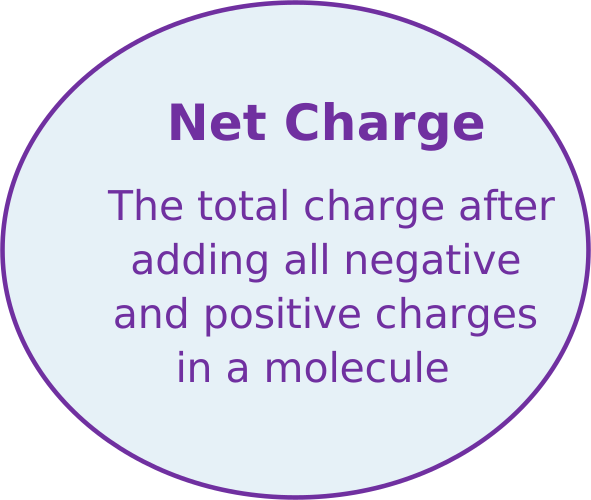
To determine the net charge, count the number of electrons in the hydrogen atom and compare it to the number of protons in a hydrogen atom. Each hydrogen atom in this image has one electron whose charge is –1. Each proton’s charge is +1. (1 X -1) + (1 X +1) = 0. The total net charge of both hydrogen atoms is 0 in this case. There are eight protons and eight electrons in the oxygen atom. (8 X –1) + (8 X +1) = 0. The oxygen atom also has a net charge of zero.
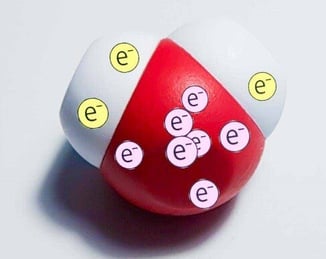
Use the same method to determine the net charge of the atoms in these water molecules. Remember to use the following formula to determine net charge.
(Number of protons X +1) + (Number of electrons X –1) = net charge.
Create a chart in your notebook to record the net charge of each of the following models.

|
|
Image A |
Image B |
Image C |
Image D |
|
Hydrogen 1 |
|
|
|
|
|
Hydrogen 2 |
|
|
|
|
|
Oxygen |
|
|
|
|
|
Molecule Net Charge |
|
|
|
|


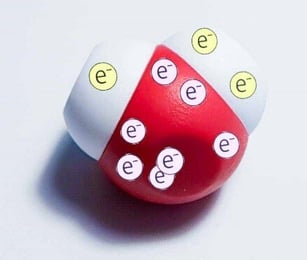


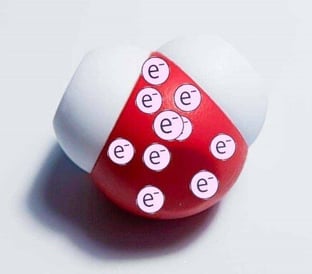
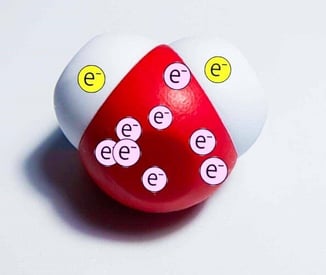
You should have determined that the net charge as follows:
|
|
Image A |
Image B |
Image C |
Image D |
|
Hydrogen 1 |
-1 |
0 |
+1 |
0 |
|
Hydrogen 2 |
0 |
-1 |
+1 |
0 |
|
Oxygen |
+1 |
+1 |
-2 |
0 |
|
Molecule Net Charge |
0 |
0 |
0 |
0 |
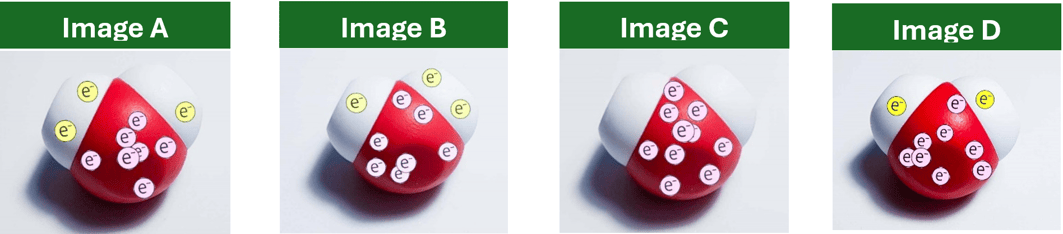
Because electrons never stay in one place for long, between the four possible scenarios, we find that on average the electrons appear to be in the oxygen atoms more often than in the hydrogen atoms. This leads to the probability that oxygen will be slightly more negative, while hydrogen will be slightly more positive. Every chemical bond requires two electrons to form.

Summarize what happens as electrons move between the atoms in the water molecule in your lab notebook.
Oxygen on one water molecule will be attracted to the hydrogen on another water molecule. This is called hydrogen bonding because this type of interaction always involves a hydrogen atom and an atom that wants additional electrons like oxygen.
Look back at the model you created to show how valence electrons from one water molecule interacted with another water molecule. Compare it to the model shown below.
To simplify showing how this interaction occurs, scientists show just the valence electrons and indicate the hydrogen bonding in green.
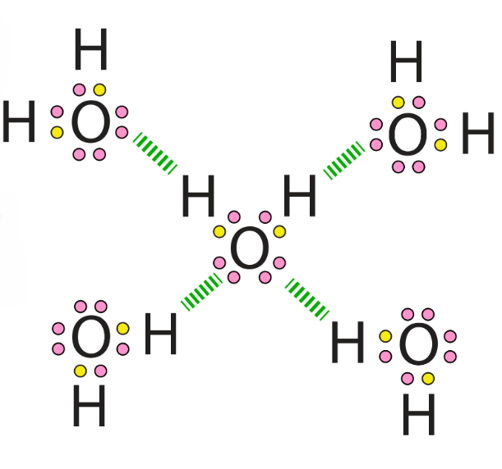

Modify your initial valence electron model to show the new information you have discovered.
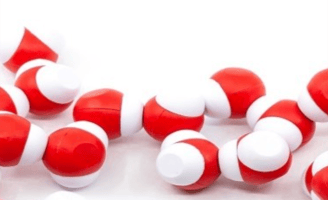
You should have noticed that hydrogen bonding has an oxygen atom forming an interaction with a hydrogen atom.
Let’s model hydrogen bonding in a couple more ways.
Gather all of the water molecules in the kit together in your hands. Roll the molecules back and forth in your hands. Notice how easily the hydrogen bonds break and reform as the molecules of water move past each other.
When a large number of water molecules are held together by hydrogen bonding, scientists call this cohesion. Cohesion plays an important role in keeping things alive. It also is responsible for keeping water together in bulk. You might think of it as the water molecules coordinating together to help you remember the word cohesion.
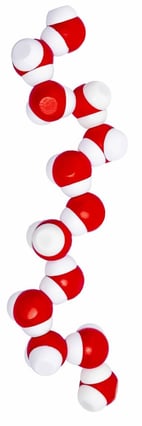
To model cohesion, combine all the water molecules in the Student Modeling Pack together in a long strand. Hold them by the water molecule at the top.
Write down your discoveries in your Notice | Wonder chart.

- Write your observations about the relative strength of hydrogen bonding in your notebook.
- How did it compare to the amount of force you needed to remove a hydrogen atom from the oxygen atom of a single water molecule?
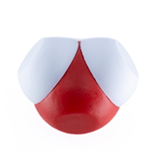
Hydrogen bonding is a much weaker interaction than the polar covalent bond between an oxygen atom and a hydrogen atom in a single water molecule.
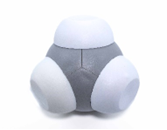
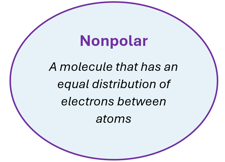
Some molecules, like methane to the left, are nonpolar. The electrons shared between the carbon and hydrogen atoms are shared equally.
Review your Notice | Wonder chart and notes in your lab notebook.
What helped you explain what hydrogen bonding is?

- Put a star by those things in your Notice | Wonder chart.
- List those statements under the heading of Evidence for Hydrogen Bonding in your notebook.
Now that you have evaluated your evidence.
Explain how hydrogen bonding occurs in your notebook by completing the statement.
Hydrogen bonding occurs when ____________________________.
Use the images and your notes from your Notice | Wonder chart to help you.
Thinking Deeper About Hydrogen Bonding and Water
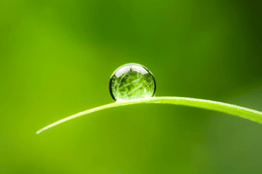 The hydrogen bonds that are modeled by this kit are very weak. They only last for a fraction of a second. In liquid water hydrogen bonds are constantly forming, then breaking, and then forming again. As the temperature of this liquid water is lowered, the hydrogen bonds last longer and longer until the water freezes into ice.
It is important to remember that the overall water molecule has no charge. Although the oxygen atom has a net negative charge, and the two hydrogen atoms have a net positive charge, when bonded, they form a molecule that has no charge.
A single water molecule cannot be seen with your eyes. There are 3 X 10²¹ or 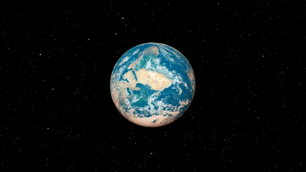
3,000,000,000,000,000,000,000 water molecules in a single drop of water. A water drop of this size would be bigger than the Earth if it was made of water molecules the size of the Water Student Modeling Pack.
Looking Back
Let’s look back at the image you thought about at the start of this lesson. The balloon has been rubbed vigorously with a wool cloth causing electrons to be transferred from the surface of the wool cloth to the surface of the balloon. The balloon is full of static electricity since its surface has an excess of electrons. Think about how the stream of water might be attracted to the balloon.
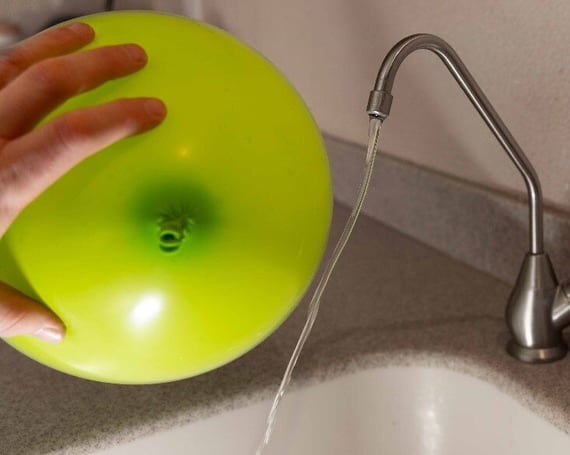
Answer the writing prompts in your notebook to help you explain what is happening in the image.

First, consider your thoughts at the beginning of the lesson.
- What were your ideas at the beginning of the lesson?
- How have your ideas changed?
Now think about the stream of water before the balloon moves near it.
- How does hydrogen bonding help the water stay in a long, unbroken stream?
- Try to sketch what is occurring at the molecular level. Be sure to show the uneven charges between the oxygen and hydrogen atoms.
Let’s think about why the water bends when the balloon comes closer to it. Remember the balloon has been rubbed with a wool cloth and has more electrons on its surface.
- How does the uneven placement of electrons within a water molecule explain why the stream of water will bend toward the negatively charged balloon?
- Add to your sketch to show what is happening at the molecular level. Be sure to show what part of the water molecule is pulled to the balloon as the balloon comes closer.
Let’s summarize what we learned:
- Atoms are made of smaller particles like electrons, protons, and neutrons.
- Water is a polar molecule with partial positive and negative charges in different regions of the molecule based on the unequal sharing of electrons.
- The oxygen of one water molecule is attracted to the hydrogen of another water molecule. This results in hydrogen bonding.
- Hydrogen bonding allows large amounts of water molecules to stay together. This is known as cohesion.
The ballon was charged with additional electrons, which gave it a slightly negative charge. The stream of water was attracted to the negative surface of the balloon, which caused the water to bend toward the balloon instead of falling straight down. Since water is polar, with slightly positive and slightly negative regions, it did not actually touch the balloon. The charge on the balloon's surface was enough to attract the slightly positive regions of the water molecules but not enough to overcome the repulsion of the slightly negative regions to touch.