





.png?width=2000&height=204&name=Phospholipids%20(2).png "Phospholipids (2)")
Modeling Challenge
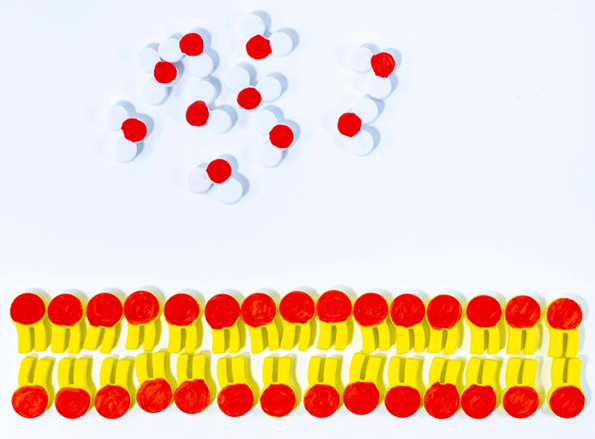
Create a lipid bilayer with your phospholipids and place your water molecules on one side. Imagine this is now a cell membrane, and the water needs to move across the membrane.
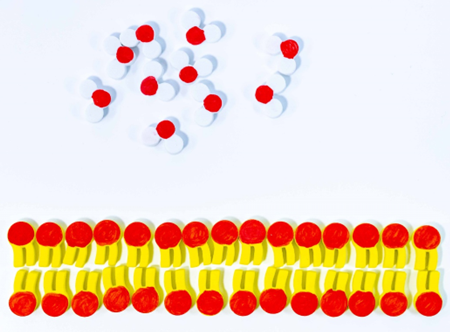
Model how this could happen. Review your notes from the Phospholipids Lesson as needed to remember the properties of phospholipids, lipid bilayers, and cell membranes.

In your lab notebook:
- Create a sketch of your model.
- Add notes about how this could work, or what would need to happen.
- Can the water just slip through the phospholipids? Why or Why not?
- What questions do you have? What do you need to know to determine if your model is correct?

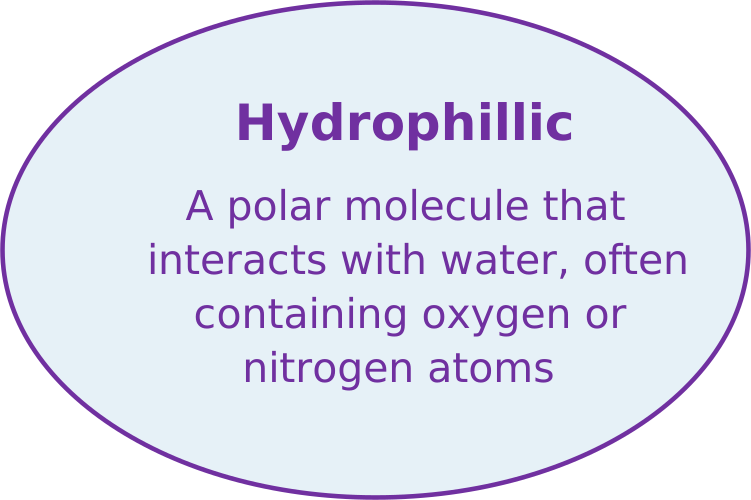
Cell membranes are made up of a phospholipid bilayer. Because the two tails of each phospholipid are hydrophobic, the membrane functions as a barrier between all the things that are inside a cell (the cytoplasm) and those things that are on the outside of the cell. In this lesson, you will learn about how many hydrophilic things – like water, glucose, and ions – are able to pass through the hydrophobic portion of the membrane rapidly.
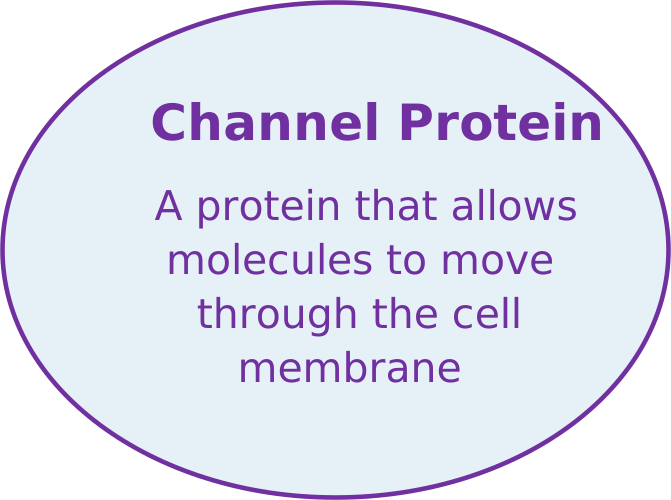
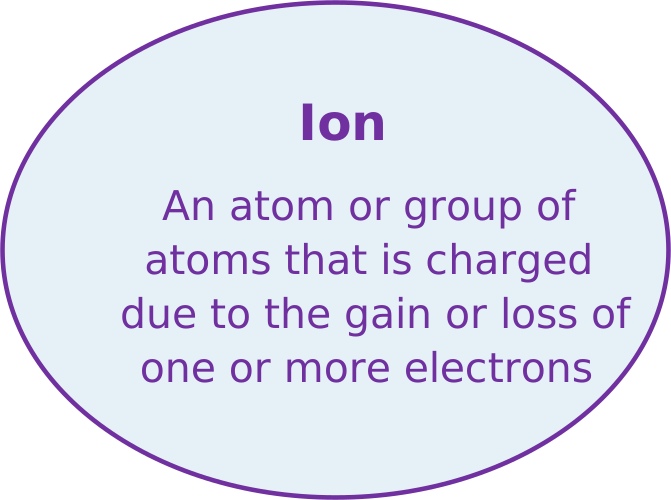
In most cases, molecules and ions cannot easily pass through lipid bilayers. They will need some type of opening, or doorway to cross the membrane. These openings or doorways are called channel proteins, and they only allow very specific molecules or ions to move through each one. Scientists typically categorize movement across membranes in three ways.
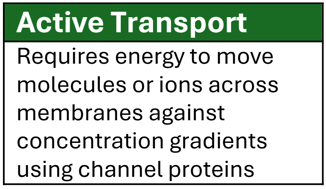
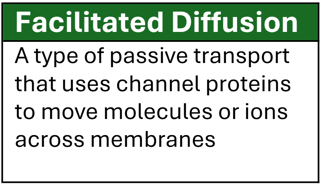
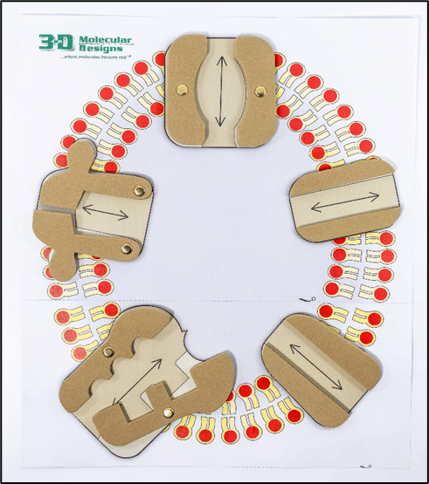
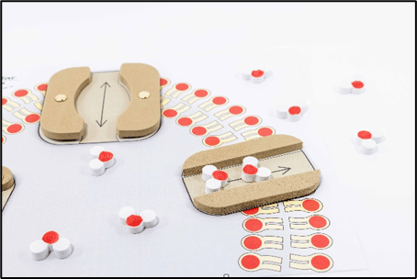
Assemble your cell membrane model if you haven’t already. This model has a cell membrane on the outside, preventing molecules on the outside from getting in and keeping the molecules on the inside where the cell can use them. Many molecules need a channel protein to move into or out of the cell.
Based on this limited information, examine your cell membrane in your Student Modeling Pack. For each of the tan channels, make predictions about the type of transport it might support.
In your lab notebook:
- Identify at least one channel that could support Active Transport and record your reasoning.
- Identify at least one channel that could support Facilitate Diffusion and record your reasoning.
- Identify how Passive Transport could occur.
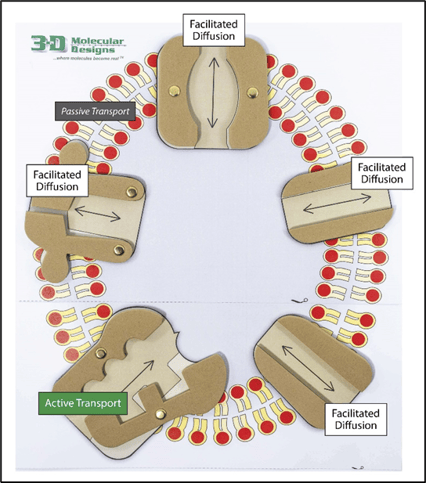 The channel in the lower left is an example of active transport because it requires ATP, or energy to function.
The other four channels are examples of facilitated diffusion that do not require energy. Some of these channels will change their shape as molecules or ions pass through, but those movements do not require energy. This type of movement is an example of passive transport.
Sometimes, ions or molecules work their way between the phospholipids without going through one of the channels. This rarely occurs with polar molecules or ions. This movement is another example of passive transport.
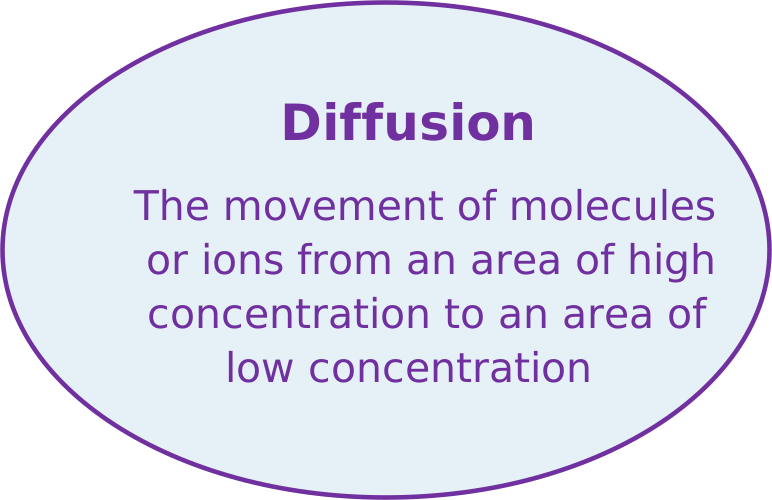
Diffusion is the process by which molecules move from areas of high concentration to areas of low concentration. This process is an example of passive transport, which means they do not need any energy input for the molecules to move.
The rate at which the molecules can move depends on many factors, including size, chemical properties, and temperature.
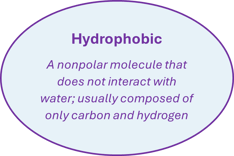
You might have imagined that water can simply diffuse through the membrane to balance the concentration on the inside and outside. However, this does not tend to happen because the polar water molecules have a very hard time passing through the nonpolar hydrocarbon tails of the phospholipid bilayer. Instead, water molecules move across the membrane through a protein called aquaporin.
Water Movement Across Cell Membranes
Water molecules need a way to move through the membrane because it is essential for maintaining the cell shape, chemical reactions inside the cell, and maintaining temperature. Aquaporin is the name of the channel protein that allows water to move into and out of the cell very quickly. Aqua is a Latin word that means “water”. Porin translates to pore or channel.
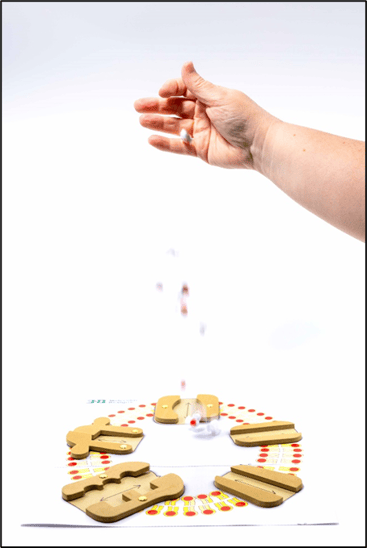 Drop all of the water molecules from 12 inches above your membrane kit. Let them bounce in/out of the cell. When they come to rest, count how many land inside the cell and count how many land outside.
 In your lab notebook:
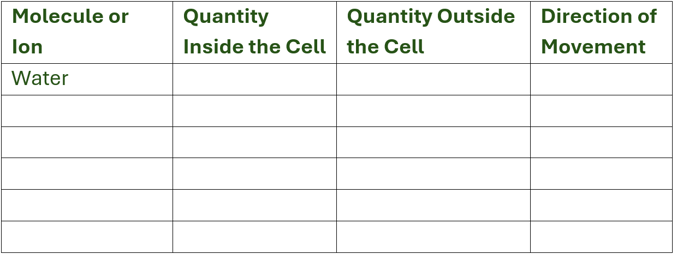
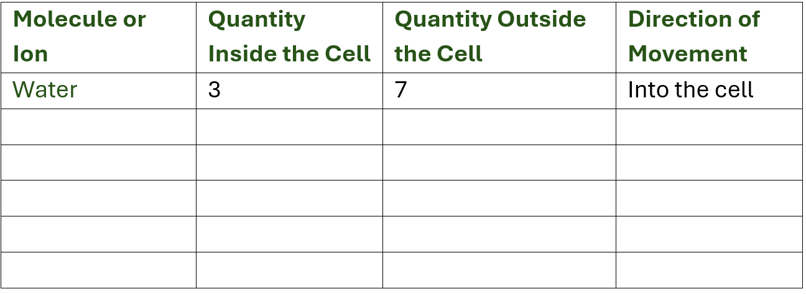
- Create a data table like the one below. Leave room for 5 more entries.
- Record the number of water molecules that are inside and outside the cell
- Indicate the direction that the water molecules move via diffusion
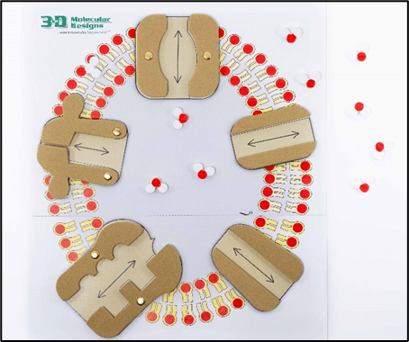
In our example, the concentration of water was higher outside the cell (7) than inside the cell (3). Water will move from outside into the cell through the aquaporin channel until there are 5 water molecules on each side of the cell membrane.
Another term for this is osmosis. Osmosis is the process of water moving across the cell membrane from areas of high concentration to areas of low concentration. It is a specific type of diffusion.
 In your lab notebook:
- Write a paragraph description of the movement of wat Identify the type of transport (active, passive, and/or facilitated diffusion). Make sure you use the following terms:
- Aquaporin
- Channel Protein
- Diffusion
- Osmosis
- Cell Membrane
Water moves across cell membranes through specialized channel proteins called aquaporin. The process is called osmosis, which is a type of diffusion because the water molecules will move from areas of high concentration to low concentration. This is an example of passive transport and facilitated diffusion because the water flows through protein channels but does not require energy.
Transporting Glucose Across Cell Membranes
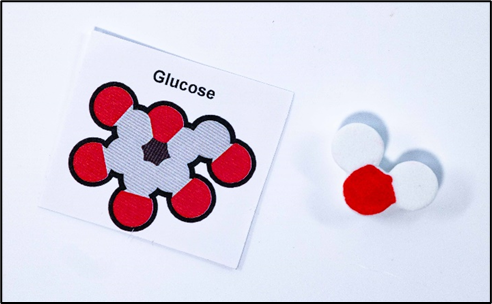 Compare the image of glucose with your water molecule model.
Glucose is a polar molecule just like water. But glucose is much larger than water, and it has a very different shape. Therefore, glucose is not able to use the same channel protein (aquaporin) that water uses to cross this membrane. Instead, glucose uses a different channel protein – GLUT1.
Glucose is a simple sugar that your cells use to generate energy. When glucose enters a cell, it is used to make a molecule called ATP – the universal currency of energy. You can think of ATP as a dollar bill. It can be used to pay for many different energy-requiring processes in the cell – like muscle contraction.
When you eat food, your digestive system breaks it down into simple molecules like glucose. Glucose is then transported to your cells through the bloodstream. But when a glucose molecule is delivered to a muscle cell, how does it cross the membrane so that it can be used to make ATP?
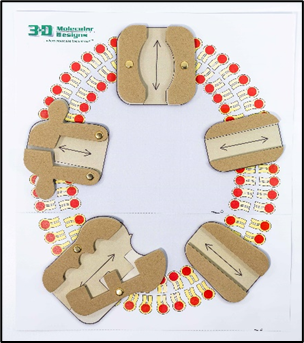
Take your cell model and identify the GLUT-1 channel and glucose molecules.
Drop all of the glucose molecules from 12 inches above your membrane kit. Let them bounce in/out of the cell. When they come to rest, count how many land inside the cell and count how many land outside.
In the data table in your lab notebook:

- Record the number of glucose molecules that are inside and outside the cell
- Indicat the direction that the glucose molecules will move to balance the concentration
- Write a paragraph description of the movement of glucose. Identify the type of transport (active, passive, and/or facilitated diffusion). Make sure you use the following terms:
-
-
-
-
- GLUT-1
- Channel Protein
- Diffusion
- Cell Membrane
-
-
-
-
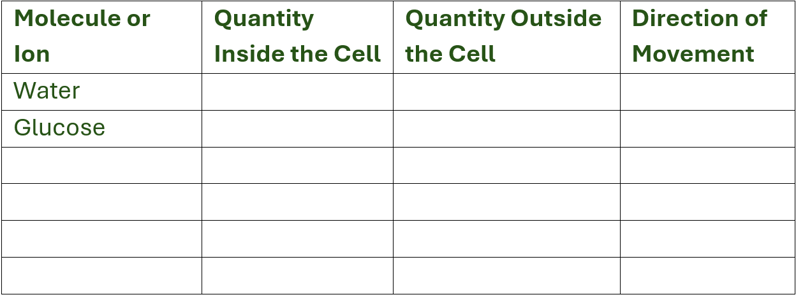
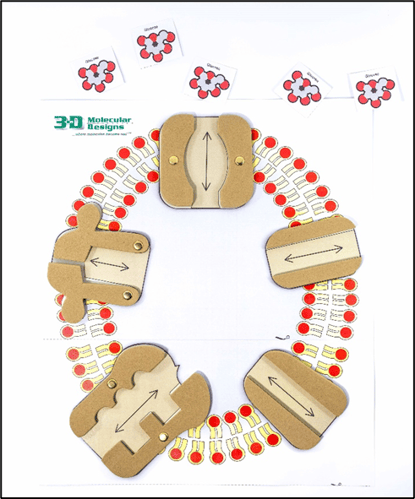
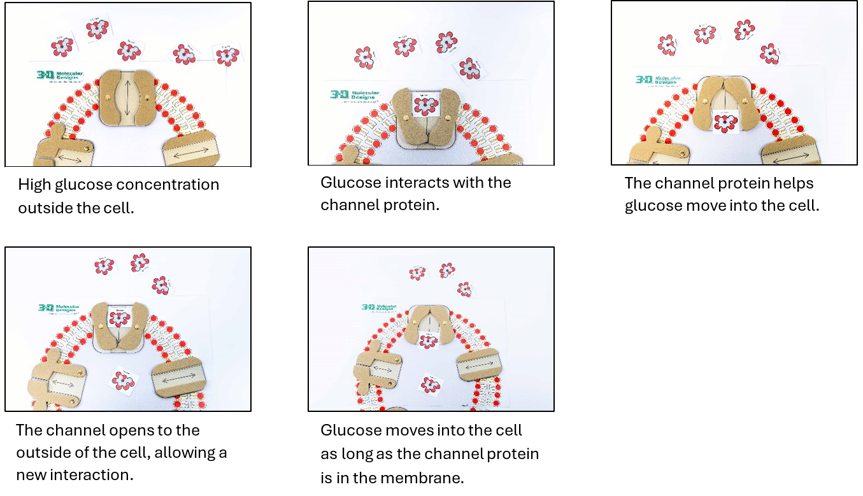
In our example, all five glucose molecules landed outside of the cell. Glucose will move into the cell until 2 or 3 molecules are inside.
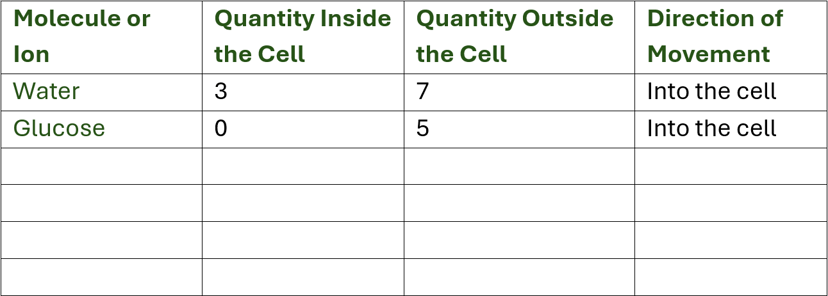
Glucose moves across cell membranes through specialized channel proteins called GLUT-1. Through the process of diffusion, the glucose molecules will move from areas of high concentration to low concentration. This is an example of passive transport and facilitated diffusion because glucose flows through protein channels but does not require energy.
You may have noticed that the GLUT-1 protein has moveable parts. The following illustrations provide more information on the movement of glucose through the channel.
Transporting Ions Across Cell Membranes
The concentration of potassium ions (K+) and sodium ions (Na+) on either side of a cell membrane plays an important role in how neurons send electrical signals from your brain to your muscle cells. These ions are very small – but their positive charges prevent them from diffusing through the hydrophobic phospholipid bilayer. Once again, specific channel proteins called Potassium Channels and Sodium Channels allow these ions to cross membranes.
Both potassium (K) and sodium (Na) on that have a charge of +1. Potassium channels work much like aquaporin and water. In contrast, sodium moves through a voltage-gated channel to get through the cell membrane. As a gated channel, it responds to changes in charges that allow it to open and close. This is a different way that it is cell membranes control the movement. Under normal conditions, the sodium ion concentration will be higher outside of the cell than inside.
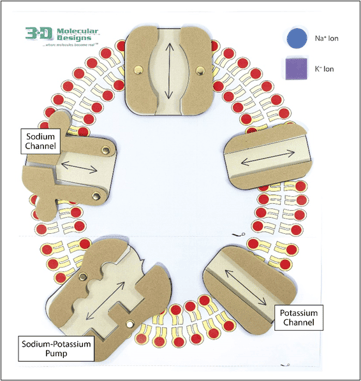
Take your cell model and identify the sodium channel, the potassium channel and their ions.
Drop all of the ions from 12 inches above your membrane kit. Let them bounce in/out of the cell. When they come to rest, count how many land inside the cell and count how many land outside.
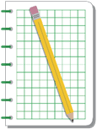 In the data table in your lab notebook:
- Record the number of each type of ion that are inside and outside the cell
- Indicate the direction that each type of ion will move to balance the concentration
- Write a paragraph description of the movement of ions. Identify the type of transport (active, passive, and/or facilitated diffusion). Make sure you use the following terms:
- Voltage-Gated Sodium Channel
- Potassium Channel
- Channel Protein
- Diffusion
- Cell Membrane
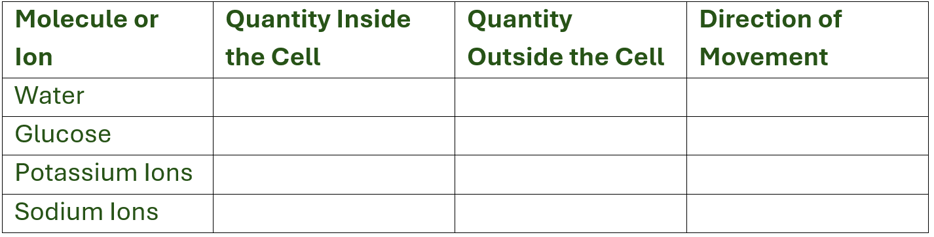
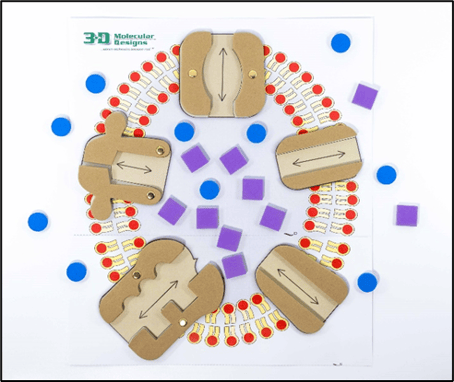
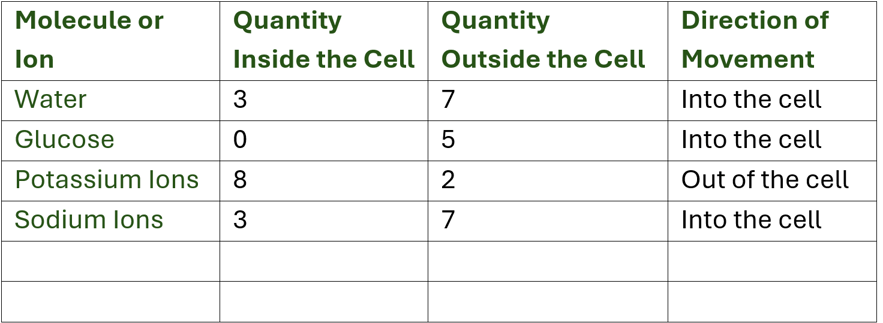
In our example, 8 K+ ions and 3 Na+ ions landed in the cell. Potassium ions will move out of the cell and sodium ions will move inside.
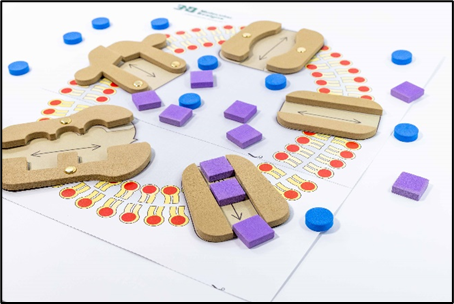
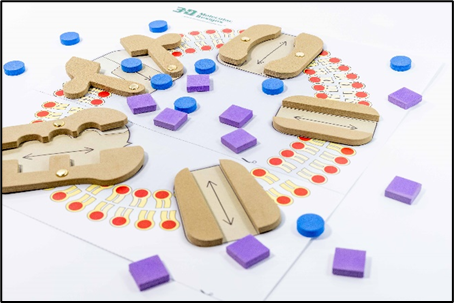
Ions move across cell membranes through specialized channel proteins such as Voltage-Gated Sodium Channels and Potassium Channels. Through the process of diffusion, the ion molecules will move from areas of high concentration to low concentration. This is an example of passive transport and facilitated diffusion because glucose flows through protein channels but does not require energy.
Sodium-Potassium Pump
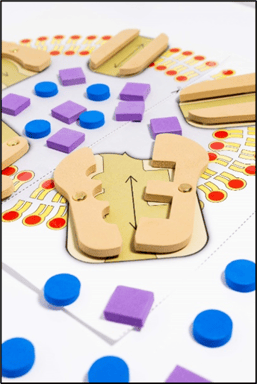
Osmosis and diffusion are ways that allow molecules to move from areas of high concentration to areas of low concentration. But sometimes the cell needs to move molecules from a low concentration to a higher concentration. Na+ ions are normally at a high concentration outside the cell and K+ ions are normally at a high concentration inside a cell? How does the cell set up this concentration difference?
To generate a high concentration of Na+ ions outside the cell and a high concentration of K+ ions inside the cell – the cell uses a pump. This pump is a protein called the Sodium-Potassium pump. It pumps sodium and potassium ions in opposite directions across a membrane. And just like other pumps that you may be familiar with, pumps require energy. In a cell, this energy is supplied in the form of ATP. (Remember that the ATP was created from the glucose we transported into the cell with the GLUT1 channel protein.)
Set up your model of ATP as shown below.
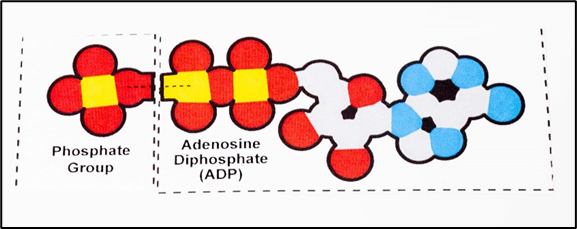
ATP stands for Adenosine TriPhosphate – an adenosine with 3 phosphates attached. When one of the phosphates is cleaved off the ATP – energy is released – and the cell will use this energy to power a change in the shape of the Sodium-Potassium Pump.
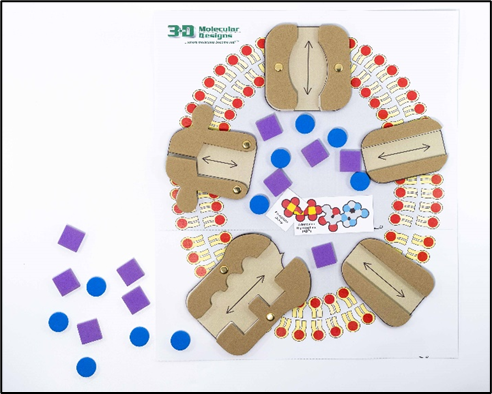
Place the ATP inside your cell model as shown in the image to the right.
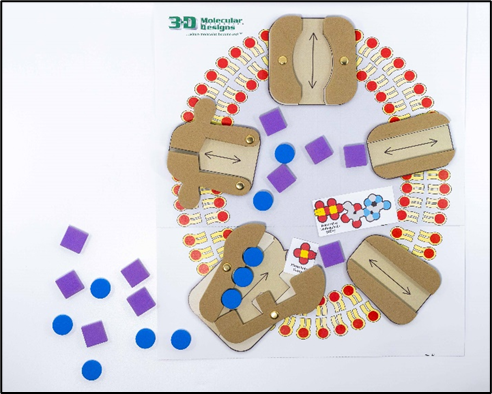
Notice that one side of the channel is the right shape to load 3 blue sodium ions from the inside of the cell.
Next, we need to use the energy from the ATP molecule. It will interact with the “pocket” in the Sodium Potassium pump.
Break the last phosphate group off to fuel the pump.
Move the rest of the molecule will move away.
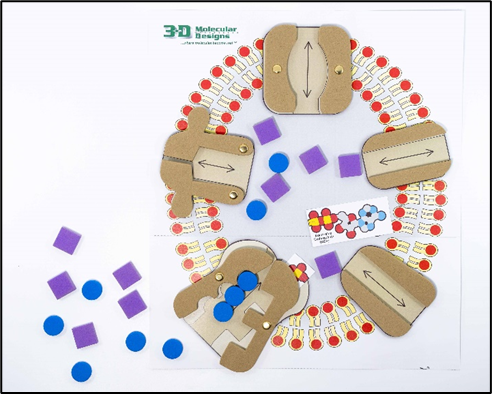
The addition of the phosphate group causes the channel to change shape.
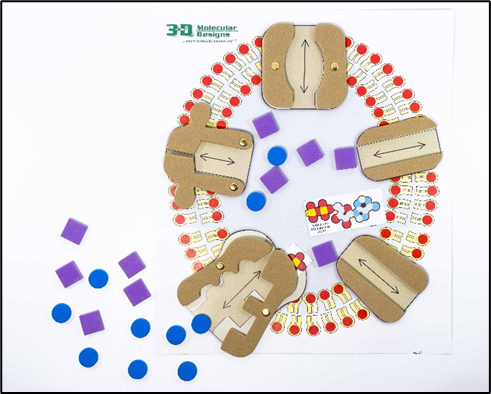
The change in shape exposes the sodium ions to the outside of the cell. Release the sodium ions from the channel.
As the sodium moves away from the channel, the other side of the channel is exposed to the outside of the cell.
 In your lab notebook:
- Predict what will happen to the potassium ions, the shape of the sodium-potassium pump, and the phosphate group from the ATP.
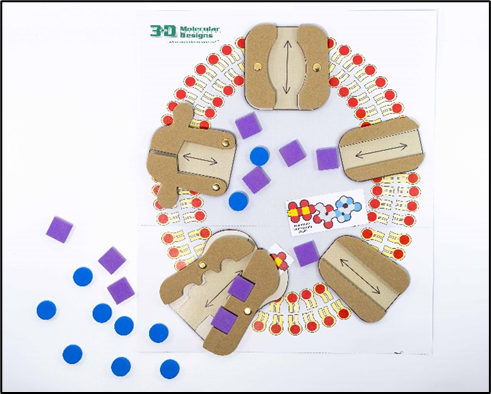
After the change in shape, two potassium ions can interact with the channel.
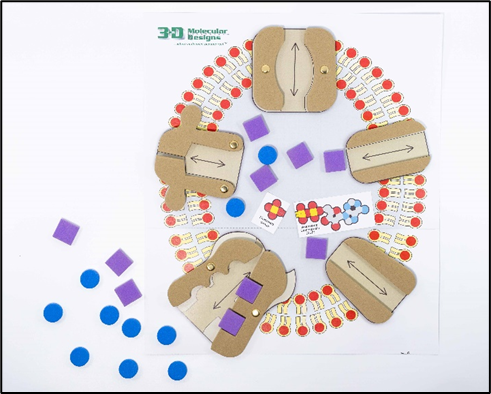
Once loaded, the channel will need to change shape again.
The phosphate group needs to break off to return to its original shape.
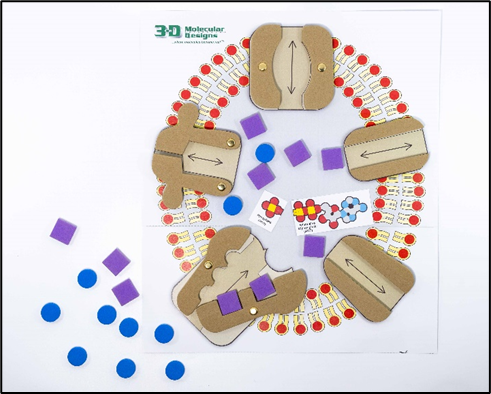
The channel will then open back to the inside of the cell.
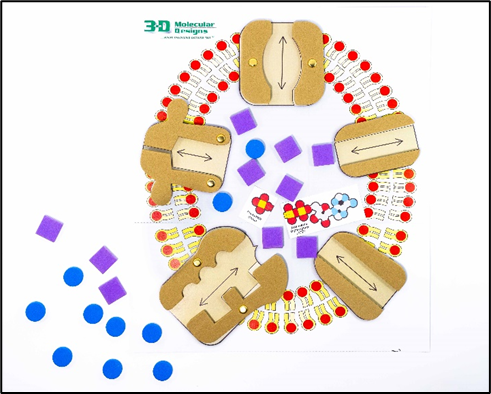
This will allow the potassium to move into the cell.
Review what you just learned by modeling the actions of the sodium and potassium channels and the sodium-potassium pump.
Drop all of the ions from 12 inches above your membrane kit. Let them bounce in/out of the cell. When they come to rest, count how many land inside the cell and count how many land outside.
 In the data table in your lab notebook:
- Draw a heavy line in your chart to separate this from your previous data sets.
- Record the number of each type of ion that are inside and outside the cell
-
Indicate the direction that each type of ion will move to balance the concentration
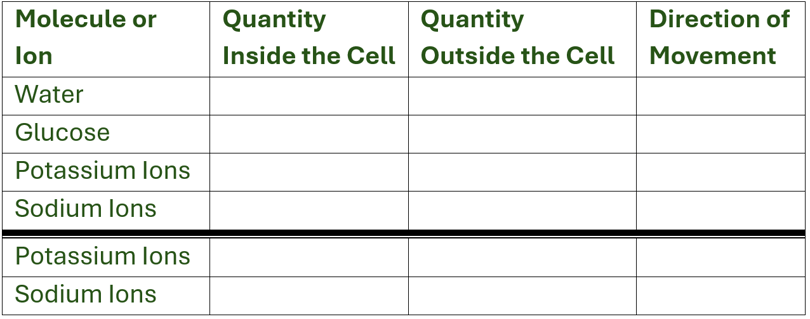
Model the diffusion of ions through the channels.
After you reach equilibrium, then move the ions against the concentration gradient using the sodium-potassium pump.
 In your lab notebook:
- Write a paragraph description of the movement of ions with the sodium-potassium pump. Identify the type of transport (active, passive, and/or facilitated diffusion). Make sure you use the following terms:
- Sodium-Potassium Pump
- Channel Protein
- Cell Membrane
- ATP
The sodium-potassium pump moves ions across the cell membrane against the concentration gradient with energy from ATP. First, three Na+ enter the pump from the inside of the cell. Then a phosphate group breaks off the ATP and changes the shape of the pump to dump the Na+ outside of the cell. Now that the pump is open to the outside, 2 K+ enters the pump, which causes it to change shape and knocks off the phosphate group while dumping the K+ into the cell. The sodium-potassium pump is a type of channel protein and is an example of active transport.
Review your Modeling Challenge from the beginning of this lesson:
Create a lipid bilayer with your phospholipids and place your water molecules on one side. Imagine this is now a cell membrane, and the water needs to move across the membrane to balance the concentration.
 In your lab notebook:
- Identify which parts of your prediction were correct.
- Identify the new concepts you learned in this lesson.